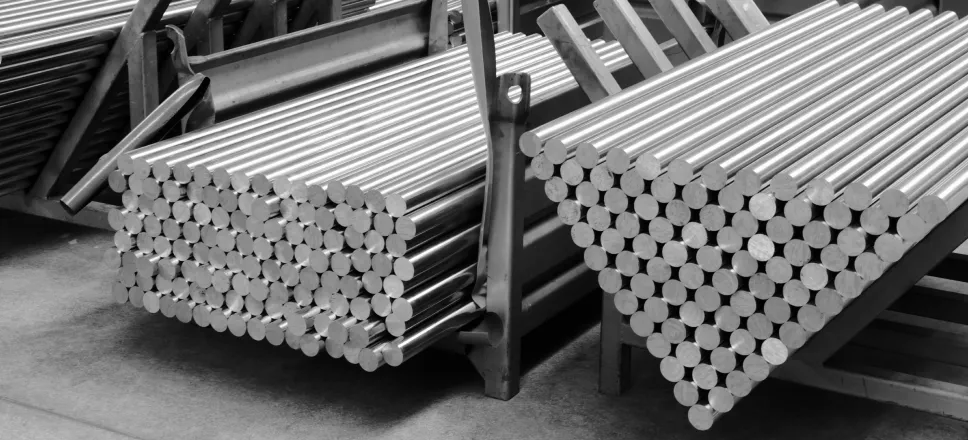
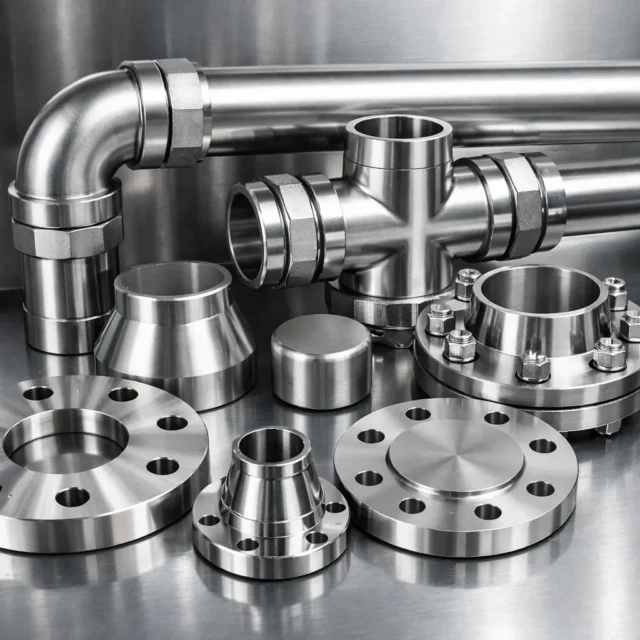
Titanium Elbows

Titanium fittings are available in several configurations to accommodate different piping layouts and installation requirements. Elbows are among the most common as they allow a piping run to change direction while maintaining a continuous flow path.

Common elbow configurations include 45° and 90° fittings, with Long-Radius (LR) and Short-Radius (SR) designs available for various applications. Other angles, such as 60° and 180°, as well as application-specific angles, may be sourced depending on project requirements and availability. TPC stocks commercially pure Grade 2 titanium elbows in 45° and 90° configurations with long- and short-radius options. Its stocked elbow sizes extend from 1/2 inch through 24 inches in nominal pipe size, with Schedule 10 and Schedule 40 options listed across the range.

Types of Titanium Pipe Fittings and Elbows

Titanium elbows are pipe fittings used to change the direction of flow within piping systems. Their combination of strength, low weight, and excellent corrosion resistance makes them well suited for demanding environments where conventional metals may experience premature deterioration. Common applications include chemical processing, marine systems, power generation, oil and gas, aerospace, and other industries where piping may be exposed to aggressive media or challenging operating conditions.

Titanium Processing Center (TPC) is a complete stocking distributor of titanium elbows, titanium pipe fittings, flanges, pipe, tube, and other titanium products. TPC supplies certified material and also provides in-house processing services to deliver material in near net-shape or near net-size condition for customers to complete their final fabrication. TPC serves industries such as aerospace, power generation, oil & gas, and defense.
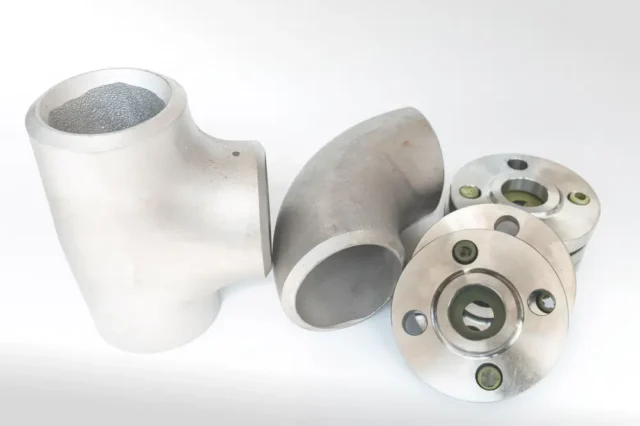
Titanium 90° Elbows

A 90° titanium elbow redirects piping by a right angle and is frequently used when a piping system must route around equipment, structural elements, or other obstructions. LR 90° elbows provide a more gradual change in direction. This can help reduce flow disruption and pressure loss compared with a tighter turn, making LR elbows a common choice where system performance and available space permit.

Short-radius 90° elbows make the directional change within a more compact footprint. They can be useful when space is limited or when piping must be routed tightly around surrounding equipment. The appropriate option depends on system dimensions, flow requirements, pressure, and available installation space.

Other Angles and Radii

A 45° elbow provides a less abrupt directional change than a 90° elbow and can be useful when piping needs to shift gradually. Depending on system requirements, 60°, 180°, and other angles may also be specified or sourced. Radius is equally important. A long-radius elbow generally provides a smoother flow path but requires more installation space. A short-radius elbow reduces the amount of space needed for the turn but creates a more abrupt directional change. Engineers and buyers should evaluate both flow characteristics and fit-up requirements when choosing between LR and SR fittings.

Titanium Tube and Tube Fittings

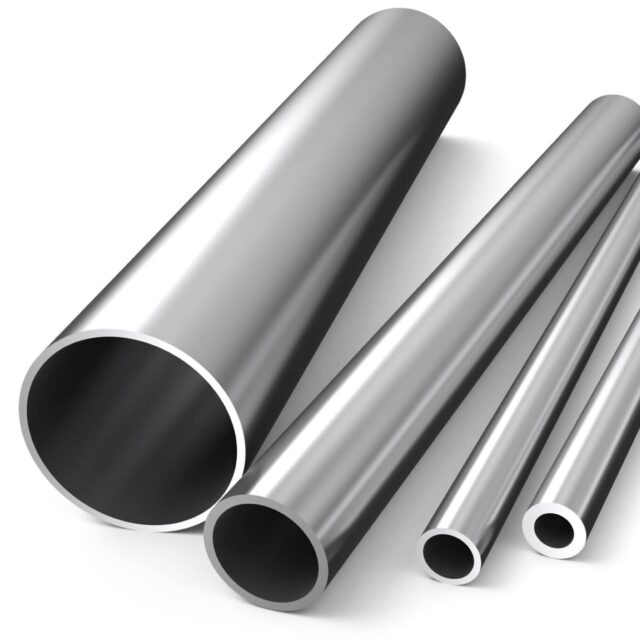
Although “pipe” and “tube” are sometimes used interchangeably, they are specified differently. Pipe is typically identified by nominal pipe size and schedule, with the schedule determining wall thickness. TPC’s titanium pipe inventory includes seamless and welded products in multiple schedules.

Tube is generally specified directly by Outside Diameter (OD) and wall thickness. TPC carries both seamless and welded titanium tube, including commercially pure Grade 2 and Grade 9 products meeting ASTM B338 specifications. When requesting fittings, clearly identify whether the application uses tube OD or nominal pipe size. This helps ensure that the fitting dimensions correspond to the rest of the system.

Threaded and Butt-Weld Titanium Fittings

Connection type is another important consideration. Threaded titanium pipe fittings provide connections that can be assembled without a welded joint. TPC stocks a range of threaded titanium pipe fittings and pipe plugs, including couplings, half couplings, and caps in multiple nominal pipe sizes.

Butt-weld fittings are designed to be joined directly to compatible pipe. For projects specifying butt-weld fittings, buyers should review the applicable dimensional requirements, including ASME B16.9 where required by the system specification. Matching nominal pipe size, schedule, wall thickness, alloy, and dimensional standard helps maintain compatibility throughout the piping system.

How to Choose the Right Titanium Fitting

Start by matching the titanium grade to the application’s chemical exposure, operating temperature, mechanical requirements, and applicable specification. Next, select the appropriate nominal pipe size or tube OD and wall thickness or schedule based on the system’s engineering requirements. Connection method also matters.

Determine whether the installation requires threaded components, butt-weld fittings, flanges, or another connection style. For elbows, consider whether a long-radius design is preferable for flow characteristics or a short-radius fitting is necessary because of space limitations.

Availability should be considered early in the sourcing process. TPC maintains stocked titanium products and can also source items that are not currently in inventory. The company states that some stocked products can be delivered in as little as two to ten days, depending on the order.

Inventory, Specifications, and Near Net-Shape Services

TPC stocks commercially pure Grade 2 titanium elbows in both 45° and 90° configurations, including LR and SR options. Listed nominal pipe sizes range from 1/2 inch to 24 inches, with Schedule 10 and Schedule 40 wall thicknesses available across the published elbow range. TPC also stocks threaded fittings and pipe plugs and supplies titanium pipe, tube, flanges, and other titanium products.

TPC maintains aerospace and quality management certifications, including AS9100, AS9120, and ISO 9001. Its AS9120 certification specifically covers the warehousing and distribution of metallic mill products, reinforcing TPC’s role as a distributor rather than a manufacturer.

For customers requiring material closer to their final dimensions, TPC offers in-house processing capabilities including band sawing, plate sawing, shearing, and waterjet cutting. These services provide near net-shape or near net-size material for customers to perform their final fabrication.

Can’t Find What You’re Looking For?

Choosing the right titanium elbows starts with clearly defining the alloy, nominal pipe size or tube OD, schedule or wall thickness, elbow angle, radius, connection type, and applicable specifications.

For projects requiring specific certifications, domestic or DFARS-compliant material, mill traceability, special sourcing, or near net-shape processing, Contact Us with a detailed description and Request a Quote from TPC.

Discover Premium Titanium Today from a Reliable Supplier.

Contact Us for Your Titanium Solutions.

Get a Quote